If you’ve searched for a ryokan or a Japanese-style family room, you’ve probably been told to “check the Japanese sites.” That means Jalan (じゃらんnet) and Rakuten Travel (楽天トラベル), the two big domestic booking sites Japanese families actually use. Many small inns, onsen ryokan and family-run hotels list their plans there.
Jalan has an English site. Rakuten Travel has an English site too, and a much richer Japanese one. The language isn’t the biggest challenge. It’s the child categories: Japanese sites don’t just ask “how many kids?” They ask whether each small child needs a meal, a futon, both or neither, and that choice changes the price.
I’m a Tokyo dad who books these sites for family trips. This guide walks through Jalan in English and Rakuten Travel’s Japanese screens, using the exact labels you’ll see. I don’t have screenshots to share, so I’ve written each button in English with its Japanese label next to it.
Ramen Dad’s note: We book family stays through Jalan or Rakuten Travel. Both work; the child categories are the part to learn.
Quick answer: Jalan vs Rakuten Travel for families
| Question | Jalan (English site) | Rakuten Travel (Japanese site) |
|---|---|---|
| Language | English, plus Chinese, Korean, Thai, Indonesian and Malay | Japanese (a separate English site exists) |
| Currency shown | JPY, USD, CNY or KRW | Yen, tax included |
| Child ages | Children 6–12; Infants 0–5 | Elementary upper / lower grades; preschoolers |
| Under-6 categories | with meals and beds / with meals / with beds / no meals and beds | 食事・布団付 / 食事のみ / 布団のみ / 食事・布団不要 |
| Japanese-style room filter | Yes: “Japanese-style” and “Japanese-Western mixed” | Search by type (旅館) and read room names for 和室 |
| Private bath filter | Shown in hotel info (“Private bath rooms”) | Yes: 貸切風呂 |
| Crib filter | Check hotel facilities | Yes: ベビーベッド |
| Payment | Usually at the hotel | Depends on the plan |
| Change a booking | No; cancel and rebook | Check your booking page |
My short answer: start on Jalan’s English site. It keeps the Japanese-style child categories and room filters, in English. Switch to Rakuten’s Japanese site when you need a filter Jalan’s English site doesn’t show, like 貸切風呂 (private bath) or ベビーベッド (crib).
Neither site is always cheaper. Compare the same hotel, room type, dates, meal plan and child categories on both sites, then check the final total, the cancellation policy and any child-related fees before booking.
The one concept you need: how Japanese sites count kids
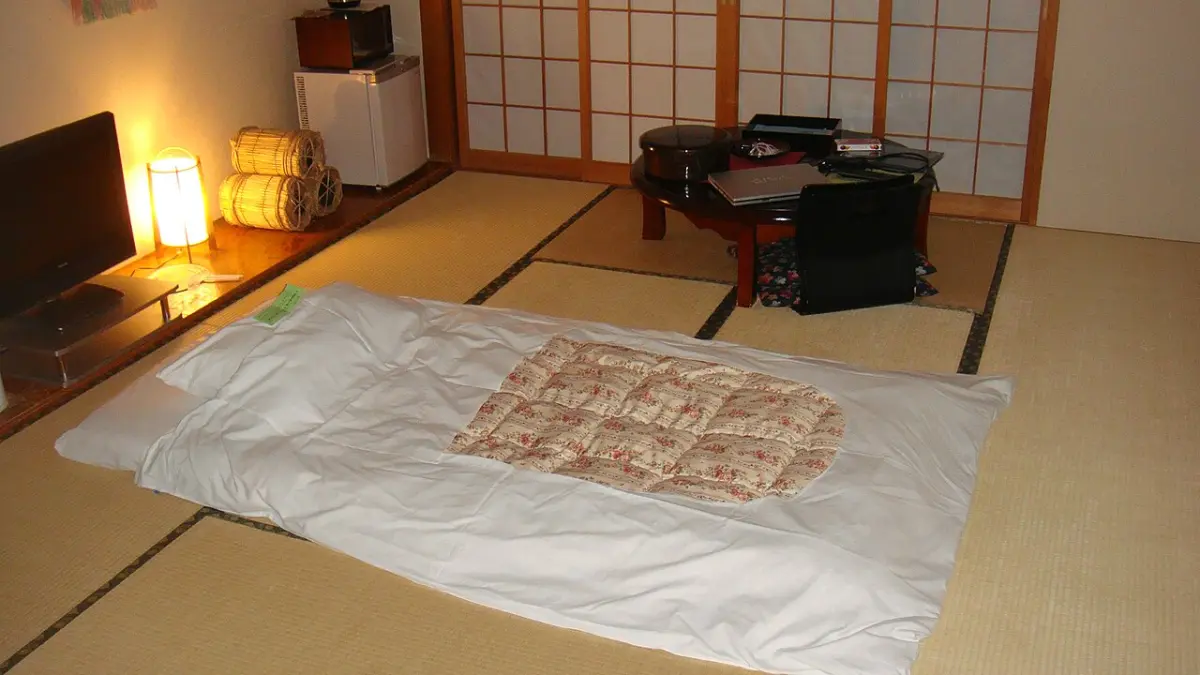
On most international sites, a child is a child. On Japanese sites, a small child is priced by what the inn has to prepare for them.
Jalan’s English help page explains the rule plainly:
- The child rate generally applies to ages 12 and under. From 13, you pay the adult rate.
- For children 5 and under, the price depends on the category you pick: with meals and beds, with meals, with beds, or no meals and beds.
- Each inn sets its own child prices, shown on the plan page in one of three ways: a percentage of the adult price, the adult price minus a fixed amount, or a fixed amount regardless of the adult price.
“No meals and beds” is what Japanese parents call soine (添い寝): the inn doesn’t prepare a separate meal or bed for your child, who shares your existing bedding. How the child eats varies by inn, so check the plan. It’s usually the cheapest category, and at some inns it’s free for the youngest children, though some inns still charge a facility fee for children. One ryokan on Rakuten, for example, says children 3 and under are free when they don’t need meals or bedding, but a 4-year-old, or a younger child who wants their own futon, is charged. Example plan on Rakuten Travel (Japanese)
Two details that catch families out:
- Meals follow the adults’ plan. On Jalan, if you choose “Child (6–12)” or “with meals” for an infant, your child gets the same number of meals as the adults. If the adults’ plan has breakfast only, the child gets breakfast only, even if you picked “with meals.”
- Futons count toward room capacity. A child who needs a futon or bed counts toward the room’s capacity, even at a child rate. Plans that can’t fit your group simply won’t show up in search. Jalan also warns that even children who don’t need bedding can push a room over the fire-safety limit, and the inn may ask you to change rooms after booking.
For the bigger picture on co-sleeping ages at Tokyo hotel chains, see my guide to Tokyo hotel rooms for a family of 4.
Ramen Dad’s note: We’ve booked my daughter as a co-sleeping child with no meals or futon. Remember that meals follow the adults’ plan.
Jalan in English, step by step
Go to jalan.net/en. Switch the currency at the top if you’d like USD.
1. The search panel
Choose your destination and dates, then the number of Room(s). For each room you set:
- Adults (13-): anyone 13 and older
- Children (6-12)
- Infants (0-5), split into four:
- with meals and beds: your child gets meals and their own futon or bed
- with meals: meals, but sleeps with you
- with beds: their own futon or bed, no meals
- no meals and beds: sleeps with you and shares your food (soine)
A family of four with kids aged 2 and 6 would usually enter: Adults 2, Children 1, Infants (no meals and beds) 1. If your 2-year-old needs their own meals, try “with meals” and compare the price.
2. Filters worth using
Jalan’s English filters cover meal type, room type, budget, accommodation type and hotel facilities. The room types are defined on Jalan’s help page:
| Filter | What it means |
|---|---|
| Japanese-style | The main room has tatami; you sleep on futons |
| Japanese-Western mixed | You can sleep Japanese-style on tatami or in beds in a Western-style room |
| Triple / 4 Beds | Three or four beds (one may be an extra bed in a triple) |
| Twin | Two beds of any size |
Meal filters are No meals, With breakfast, With dinner and With breakfast and dinner.
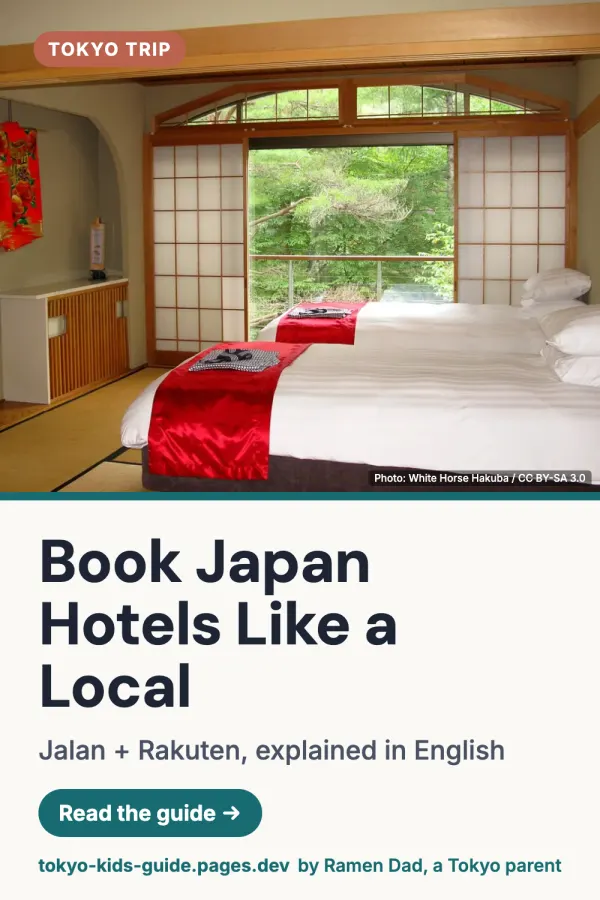
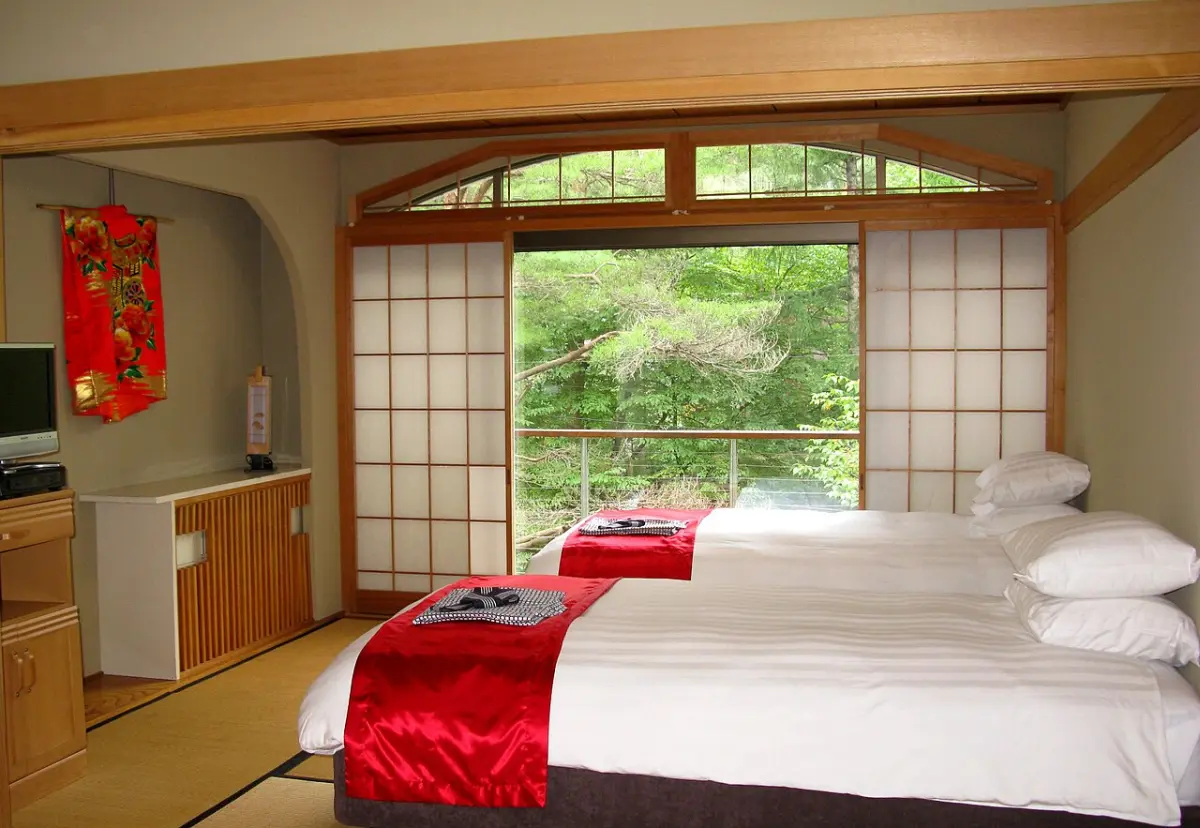
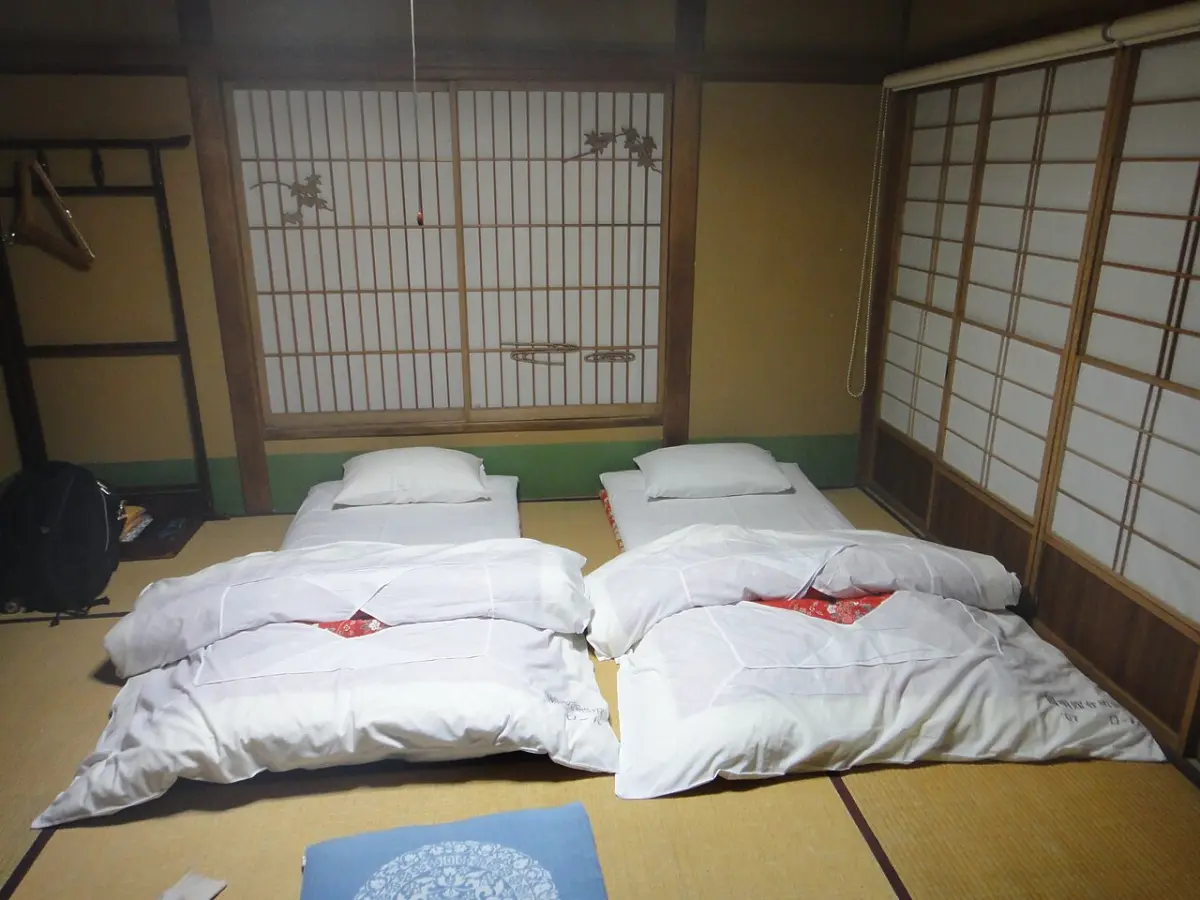
For families with toddlers, Japanese-style is the filter I’d tick first: a futon on the floor means one less thing to worry about if your toddler rolls over in their sleep. My Hakone ryokan guide goes into futon rooms and in-room baths in more detail.
3. Reading the hotel page
A few labels on Jalan’s English hotel pages are worth knowing:
- Foreign language support uses stars: ★★★ means a native or near-native speaker, ★★ means staff who handle daily conversation, and ★ means a little or translation tools.
- Private bath rooms means a shared bath you can lock or sign as “in use” for your group. “With conditions” can mean limits on age, time, price, reservations or group size, so open the details.
- Charter available under outdoor baths means you can book the outdoor bath privately. Guest rooms with outdoor bath room means some rooms have their own.
- Notices is where you’ll find extra fees, including facility fees some inns charge for children.
4. Booking
You enter your name, address and phone number (with country code), then confirm your email with a 4-digit code. If the plan shows “Questions from the Hotel,” Jalan recommends writing your children’s ages there. Do it: it’s a simple way to help prevent unexpected charges or misunderstandings at check-in.
Before confirming, check the payment details shown for your plan. Jalan’s English pages say payment is taken at the property and, in principle, in Japanese yen; the USD figure is only for reference. Don’t assume every inn accepts the same credit cards. If your card might not work, contact the inn or bring enough yen.
Ramen Dad’s note: I’ve written my daughter’s age in the hotel’s question box on Jalan. It’s a simple way to help prevent surprises on arrival.
What Jalan’s English site doesn’t do
Jalan’s English how-to page lists a few differences from the Japanese site:
- No points. You can’t earn or redeem Jalan points, and you can’t post reviews.
- No changes. You can’t modify a booking. To change dates or guest numbers, cancel and rebook. Before you cancel, check that the new room is still available and whether a cancellation fee applies: rebooking may cost more, and you could lose your original room.
- Payment at the hotel. Jalan says payment is taken at the accommodation. Bring your confirmation email.
- Some inns ask for a deposit, by bank transfer or another method, by a set date. If you don’t pay, the inn may contact you and can cancel.
- Cancellation: you can cancel online until the deadline shown on your booking; after that, you call the inn with your reservation number. Cancellation fees follow each inn’s policy.
If you’re booking far ahead, check whether the plan you want needs a deposit before you pick it. Sending a small bank transfer to Japan from abroad can be slow and costly.
Rakuten Travel’s Japanese site: the labels to know
Rakuten Travel’s English site, travel.rakuten.com, shows prices in US dollars on the US version and is fine for city hotels. For ryokan stays and family plans, the Japanese site at travel.rakuten.co.jp has more detailed search filters, and Chrome’s built-in translate handles most of it. These are the labels that matter.
The child categories (子供)
Click 子供 (children) in the search box and you’ll see:
| Japanese label | What it means |
|---|---|
| 大人 (12歳以上) | Adults, 12 and over |
| 子供(9~11歳) / 小学生 高学年 | Elementary school, upper grades |
| 子供(6~8歳) / 小学生 低学年 | Elementary school, lower grades |
| 幼児 食事・布団付(3~5歳) | Preschooler with meals and own futon |
| 幼児 食事のみ | Preschooler, meals only |
| 幼児 布団のみ | Preschooler, own futon only |
| 幼児 食事・布団不要 | Preschooler, no meals or futon (soine) |
| 幼児(0~2歳) | Babies and toddlers 0–2 |
Rakuten shows these in two places with slightly different wording: the older search box uses the school-grade names, while the newer pop-up shows the age ranges. Either way, enter each child once, in the category that matches what they need. These age labels are a guide, not a universal pricing rule: some properties use different age cutoffs or co-sleeping policies, so follow the instructions on the specific plan.
The filters (絞り込み)
Down the side of the results page, under 絞り込み (narrow down):
| Japanese | English | Why families use it |
|---|---|---|
| 旅館 | Ryokan | Usually Japanese-style rooms and dinner plans |
| 貸切風呂 | Private bath | Bathe together as a family |
| 露天風呂付き客室 | Room with outdoor bath | Your own bath, no schedule |
| ベビーベッド | Crib | Lends a baby cot |
| 朝食あり / 夕食あり / 食事なし | Breakfast / dinner / no meals | Meal plan |
| 禁煙ルーム | Non-smoking room | |
| 駅から徒歩5分以内 | Within 5 min of a station | Less walking with a stroller |
| レイトチェックアウト | Late checkout | Nap-friendly mornings |
| アパートメント | Apartment | Kitchen and space |
| クレジットカード決済 / 現地でカード利用可 | Online card payment / Card accepted at the property | Know how you’ll pay |
The budget filter is 合計料金, the total per room per night including tax, not per person. It’s a search filter, so check the final total for your whole stay on the plan page before you confirm. Filter options can also differ by search screen, and a facility filter like ベビーベッド doesn’t guarantee one is free or reserved for you; confirm on the plan or with the inn.
Words to look for on the plan page
- 添い寝 (soine): co-sleeping. Plans often state a limit, like one inn’s “添い寝は、1室2名様までとなります” (up to two co-sleeping children per room).
- 和室 (washitsu): Japanese-style room. 和洋室 (wayoshitsu): a room with beds plus a tatami area.
- 備考欄 (bikō-ran): the notes box. One family inn on Rakuten asks single parents to book as two adults and write “1 adult, X children” there. Example plan (Japanese)
Ramen Dad’s note: I filter Rakuten Travel for family stays myself. Look for 添い寝, 和室 and the notes box on each plan page.
Hotels with their own rules: a real example
Even when you pick the right category, some hotels ask you to enter kids in a specific box. Vessel Hotels, for example, lets children 18 and under stay free when they share existing bedding with a parent or grandparent. It asks families to put co-sleeping children of elementary age up to 17 in the “elementary school” field, and to write the age and number of older co-sleeping kids in the requests box. A child who needs their own bed is booked and charged as an adult, and if one adult and one child use a twin room, the price is for two adults. Breakfast for co-sleeping children is free for ages 0–5 and paid separately at check-in from age 6, but at least one property (VESSEL INN SHIGA MORIYAMA STATION) charges children the adult rate, so check the individual hotel. Vessel Hotels notice
The lesson: read the plan’s child rules before you trust the price on the search page.
FAQ from parents
“Is Jalan’s English site the same as the Japanese one?” It’s the same company and many of the same inns, but the English site has fewer membership features: no points, no reviews and no booking changes.
“Which category do I pick for a 2-year-old who shares our futon?” On Jalan: Infants (0–5), “no meals and beds.” On Rakuten’s Japanese site: 幼児 食事・布団不要, or 幼児(0~2歳) in the newer pop-up. Check the plan’s child rules to see whether it’s free.
“Can I just book everyone as adults to be safe?” You can, but you’ll often pay far more than necessary. Use the child categories, then write the ages in the hotel’s question or notes box.
“Do I need a Japanese phone number?” Jalan’s English site asks for a phone number with your country code, so it expects overseas numbers.
“Can I use a US credit card?” It depends on the property and plan. Jalan’s English site says you pay at the property, so check whether the inn takes your card. On Rakuten’s Japanese site, the クレジットカード決済 (online card payment) and 現地でカード利用可 (card accepted at the property) filters help narrow it down. Contact the property if your card isn’t accepted.
“Is it safe to use Google Translate on Rakuten Travel?” Browser translation helps you understand the pages, but don’t rely on it alone for child pricing, cancellation rules or payment conditions. Double-check the original Japanese labels in this guide before booking.
“Where do I find hotels near Tokyo Station or Disney?” Jalan’s English map search groups Tokyo into areas like “Ginza, Nihonbashi, Around Tokyo Station” and “Maihama, Urayasu” (for Tokyo Disney Resort). My Tokyo Disney with a toddler guide covers getting to the parks.
Before you book: Jalan and Rakuten checklist
- Write down each child’s age on the check-in date.
- Decide what each under-6 needs: meals, a futon, both or neither.
- Tick “Japanese-style” (Jalan) or 旅館 (Rakuten) if you want a futon room.
- Open the plan’s child rules and Notices before you trust the search price.
- Write your kids’ ages in “Questions from the Hotel” (Jalan) or 備考欄 (Rakuten).
- Check for a deposit, the payment method and the online cancellation deadline.
- Plan your luggage: ryokan in the countryside are easier with bags sent ahead. See my guide to luggage forwarding in Japan.
Ramen Dad’s note: If you remember one thing: open each plan’s child rules before you trust the search price.
Labels and rules were checked against Jalan’s English help pages, Jalan’s and Rakuten Travel’s Japanese search pages, and hotels’ official notices on October 9, 2026. Booking sites change their screens often, so the exact wording may move around.